
AXISVM
The ideal solution for structural engineers
Reliability
AXISVM finite element analysis and design software has been supporting engineers in Hungary and in many other countries around the world since 1991.
The development goals of each new version are primarily determined by feedback from users, ensuring that the software covers general needs and follows the rapid development of building technology. Thanks to this successful strategy, more than 8,000 users are already modelling with AXISVM in 45 countries around the world. We also offer fast and professional software support.
Flexibility
AXISVM is available in nine basic configurations, which differ in their applicable finite elements and analysis methods. Users can supplement the basic configuration with various design and interface modules, designed to meet their design needs and the requirements of other CAD applications.
Large, complex structures can also be modeled expeditiously. With extensive module options, the overall design process for reinforced concrete, steel, timber, and masonry structures can be quickly performed according to various national adaptations of the Eurocode, SIA (Swiss), or NTC (Italian) standards. The ability to set a wide range of global design parameters also allows for the application of national adaptations that may not yet be implemented in the software.
Specialization
Fire design is available for steel, RC and timber structures according to different standards. For steel elements, the critical temperature can be determined. The module packages contain more unique structural solutions. Structures with composite slab or column, post-tensioned beams and slabs, or CLT panels can also be designed. Earthquake design can be performed by modal response spectrum, pushover, or time-history analyses, and can even take into account seismic dampers and isolators.
The time-consuming process of documentation can also be significantly accelerated with the help of intelligent templates. An extensive data connection is provided for use with other CAD software (ArchiCAD, Revit, Tekla Structures, AllPlan and many others) through Open and Closed BIM technologies.
Basic packages
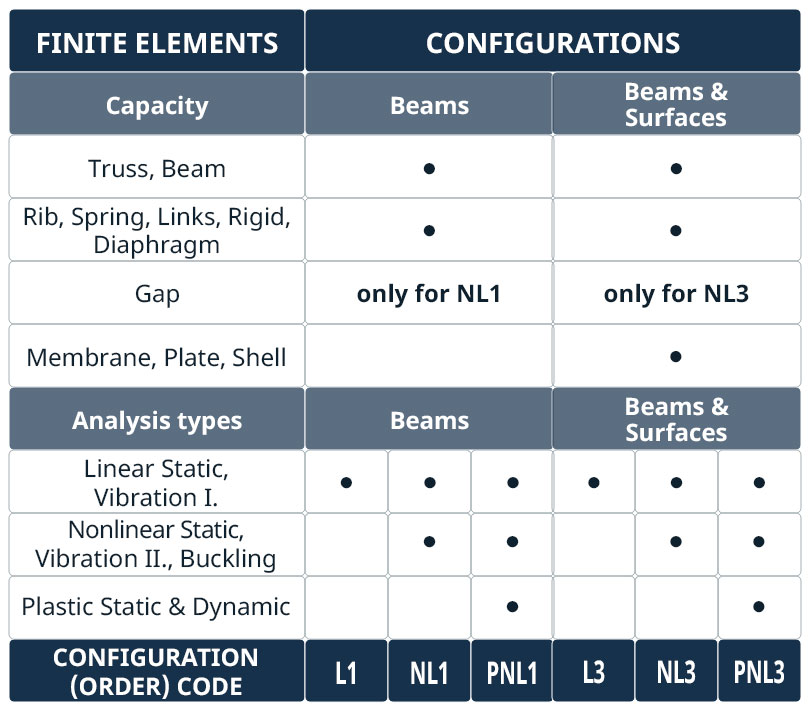
L package: For linear static and linear vibration analyses.
NL package: In addition to linear computational capabilities, nonlinear static, second-order vibration, and buckling analyses are also available. Some examples of cases these may be applied to are:
- tension-only or compression-only trusses
- nonlinear nodal, line, or surface supports
- contact modelling
- nonlinear end releases or edge hinges
- nonlinear static and dynamic analysis of structures with large displacements
- determination of buckling shapes, local buckling modes, and critical load multipliers
- vibration analysis considering the second-order effect due the axial forces.
PNL package: Analysis of beam, rib, and surface elements with nonlinear materials in the following cases:
- elastic-plastic and nonlinear-elastic material models
- analysis of plastic behaviour
- determination of permanent deformations
Module groups
RC structures
The modules for reinforced concrete (RC) structures provide an efficient solution to the design of columns, beams, wall, slab, shell, and footing systems. Modelling of post-tensioned beams and slabs is also possible. Considering actual reinforcements in the analysis, the nonlinear displacement of the structure can be evaluated more accurately. Fire design for complex RC structures is available (RC8-B and RC8-S modules).
Steel structures
The module group developed for steel structures allows for the design of steel members. A fire load case can also be considered. The optimization module can assist in finding more economical designs.
The SC1 module covers the design of the most commonly used welded and bolted steel joints.
Timber structures
In the modules developed for timber structures, simple and complex space frame structures can be analysed, cross-sections can be optimised considering various criteria, and the reliability of these structures under fire condition can be ensured.
The unique cross-laminated timber (XLM) design module provides an appropriate theoretical and computing background for the design of these novel structures.
Masonry structures
This module allows for the comprehensive design of unreinforced masonry walls subjected to mainly vertical loads and shear forces. Walls can be analysed either as a single wall or as a complex multi-storey wall segment.
The wall-slab connection, which can have a significant influence on load capacity, can be considered.
Seismic analyses
The earthquake resistance of structures can be verified by modal response spectrum, pushover, or time-history analyses, according to the Eurocode, NTC, or SIA standards.
In the analysis, the effect of seismic isolators and dampers on the structural response can also be considered.
Dynamic analyses
The DYN module is suitable for the numerical solution of general dynamics problems considering linear or non-linear material properties and geometric nonlinearity. The FFA module is specialized to determine and check the accelerations of slabs and stairs due to human-induced vibrations.
Meteorological loads
The modules provide solutions for the automatic generation and complex handling of wind and snow loads acting on structures.
They are applicable to standard structural model types or to unique-shaped structures using wind tunnel simulation. There are powerful result visualisation options to handle a significant number of load combinations.
BIM collaboration
The advanced BIM connectivity (IFC based or special interface) allows direct two-directional data exchange with any other software using BIM technology (e.g. ArchiCAD, AutoDesk ADT, Revit, Nemetschek Allplan, Tekla Structures, etc.). With such extensive connectivity, the changes in a model can be tracked, assisting the cooperation of architects and engineers working on the design.
61440 Oberursel
Germany
+49 1520 974 0790
info@gordiuscut.com
Angaben gemäß § 5 TMG
Gordius Cut GmbH
Zimmersmühlenweg 62
61440 Oberursel
Email: peter.kollar@gordiuscut.com
Umsatzsteuer-ID
Umsatzsteuer-Identifikationsnummer:
DE 328806247
HRB 14865 Registergericht
Amtsgericht Bad Homburg v.d.H.
Vertreten durch: Peter Kollar